Natural metal roof comparison
A copper vs zinc roof decision usually turns on color, budget and the style of the house. Copper starts bright, goes brown within months and can hold that brown for decades in North Texas. Zinc settles into a quiet blue-gray, usually costs less than copper and suits cleaner, modern lines. Either one can serve for generations when the details under and around it are right.
Permanent Metal Roofing Systems forms and installs both metals. To price one for your home, see our copper and zinc roofing page.
How Do Copper and Zinc Compare Side by Side?
Copper wins on warmth of color, ease of forming and sheer longevity. Zinc wins on price, a calmer look and gentler runoff. Both are soft enough to dent in big hail.
| Factor | Copper | Zinc |
|---|---|---|
| Color on day one | Bright metallic pink-orange | Bright silver, or factory pre-weathered blue-gray or graphite |
| Color after years outdoors | Deep brown in a dry climate; green only after long, wet exposure | An even, matte gray |
| Expected service life | 100 years or more, per copper industry figures | 80 to 100 years when designed for it, per a zinc maker |
| Weight of the sheet | About 1 lb for each sq ft at 16 oz; 1.25 lb at 20 oz | About 1 to 1.2 lb for each sq ft at .7 to .8 mm |
| Movement in heat | More than steel | Roughly double that of steel |
| Its runoff | Stains light masonry; corrodes zinc, aluminum and coated steel downhill | Far less staining potential than copper |
| What goes underneath | High-temperature underlayment | A vented space or structured mat so the back can dry |
| Relative cost | Usually the costliest roofing metal | Usually a step below copper |
How Does Each Metal Change Color as It Weathers?
Copper changes a lot, and zinc changes a little. In both cases the color is a thin patina the metal grows to protect itself, so the weathered look is the finish, not a flaw.
New copper stays bright only briefly, then turns brown and deepens toward chocolate. The green on old church spires takes years of repeated wetting. In NRCA’s Professional Roofing magazine, a Copper Development Association manager notes that copper in arid climates tends to stay nut-brown or ebony, usually reaching a stable color within one to three decades.
North Texas sits between desert and coast, so expect brown for a long time, with any green showing first on flatter, wetter spots. Factory-patinated copper exists for owners who want green now.
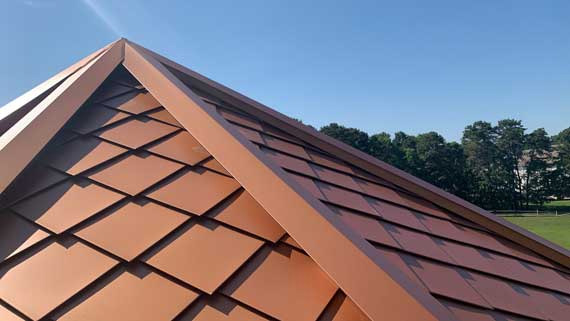
Zinc starts as a bright, faintly bluish silver, and a zinc roof’s patina slowly dulls it to a soft, even gray. Many owners order pre-weathered zinc, which arrives already blue-gray or graphite so the roof looks settled on day one. As Fine Homebuilding notes, the patina that keeps forming outdoors evens out installation scratches.
How Long Does a Copper Roof Last Compared With Zinc?
Both rank among the longest-lived roofs you can buy, and copper has the edge on paper. The Professional Roofing article puts copper at 100 years or more. A Rheinzink America manager, writing in the trade publication Design and Build with Metal, cites an 80 to 100 year service life for zinc when the drawings address slope, ventilation and its other needs.
Painted steel, by comparison, usually lasts 40 to 70 years here. On copper or zinc, the details fail long before the sheet does: clips that pin the metal, mismatched flashing, trapped moisture or incompatible runoff.
The Lifetime Non-Prorated Limited Warranty on Permanent Metal Roofing Systems standing seam spans material and labor and can move to a new owner once when the house sells. Acts of God (tornado, hail, high wind, fire, flood) sit outside it as insurance matters. For copper and zinc work, the terms that apply are written on your estimate, and the 40-year coil-coater finish warranty on our standard PVDF colors does not apply because bare copper and zinc carry no paint. Terms are on our warranties page.
Which Metal Is Easier to Shape for Turrets, Bays and Mansards?
Copper is the more forgiving metal to form, which is why it dominates curved and ornate work. Zinc shapes beautifully too, but it asks for more care with temperature and bend radius. Both go on as flat lock, diamond or seamed panels, and only the seamed panel suits a low slope; see mechanical lock standing seam.
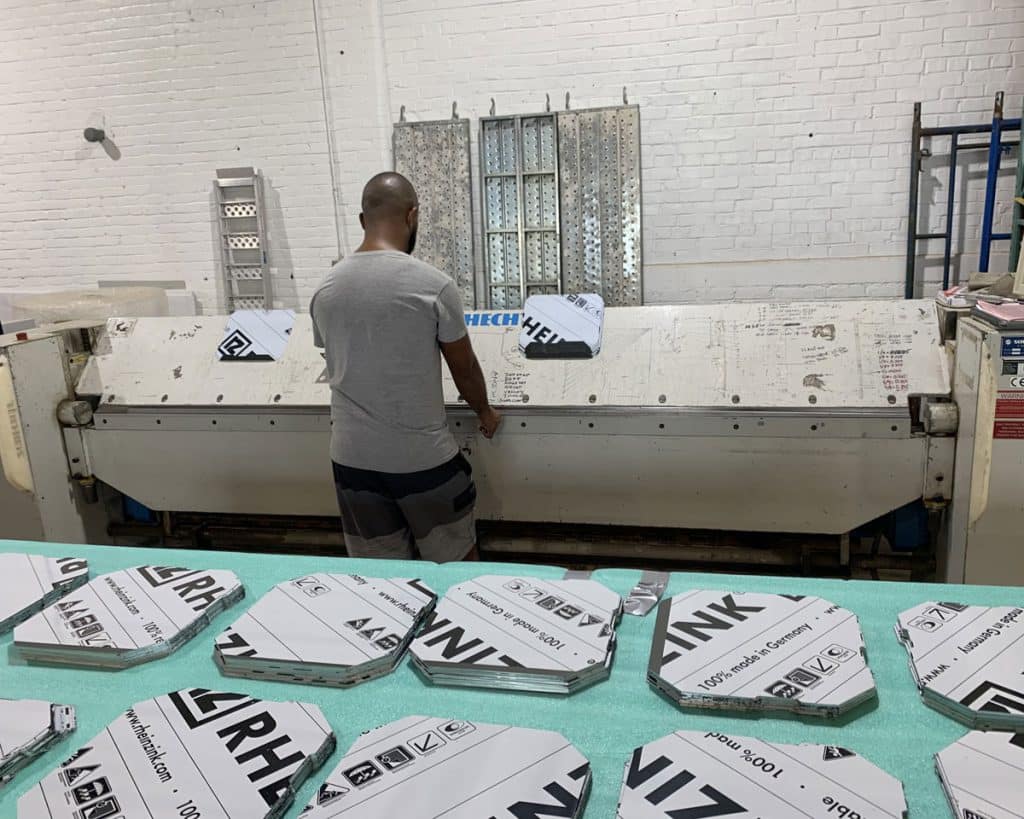
Copper bends and solders easily in any season, so it is the usual pick for finials, cupolas, eyebrow dormers and tight curves. Zinc grows brittle as it gets cold. The Rheinzink guidance calls for warming bends below about 48 degrees and keeping bend radii generous so the metal does not crack.
Where Can Copper and Zinc Drain, and What Can They Touch?
Copper can sit almost anywhere, but its water cannot. Rain leaving a copper surface carries dissolved copper that attacks zinc, aluminum and galvanized or Galvalume steel wherever it lands.
A metal roofing technical bulletin on dissimilar metal corrosion calls copper’s effect on steel, aluminum and zinc very severe and warns that water draining from copper onto a less noble metal causes corrosion and staining. So a copper bay can sit below a painted steel roof, but steel, aluminum or zinc should never sit below copper. If one design uses both copper and zinc, the zinc goes uphill.
Copper runoff also streaks limestone, stucco and pale concrete blue-green, while a New Zealand metal roofing trade group rates zinc runoff as less likely to stain. Zinc has its own sensitivity: the Rheinzink guidance warns that wet mortar and runoff from acidic woods can pit or stain it, so chimney and wall details get planned first.
Clips and fasteners follow the roof metal: copper or stainless steel on copper, stainless steel or a zinc-compatible coating on zinc. Flashing comes from the same metal as the roof; our flashing page shows the pieces we bend.
What Does Zinc Need Underneath That Copper Does Not?
A way for its back side to dry. Zinc protects itself with a patina that forms only where the surface meets air and dries out, so moisture trapped underneath can corrode a zinc roof from below.
Rheinzink’s guidance raises zinc pans on a structured mat that leaves roughly a 3/8-inch airspace, or builds a vented space beneath them. It also rules out moisture-holding sheets such as red rosin paper, a slip sheet long used under copper. The New Zealand metal roofing makers’ association gives the same advice: vent flat zinc panels from underneath.
That matters here. Dallas humidity averages about 62 percent, and clear spring and fall nights cool a roof fast after a warm day. Copper tolerates a conventional underlayment and slip sheet. Under either metal, we lay underlayment rated for the heat a sunlit metal roof reaches.
How Do Copper and Zinc Handle Texas Heat and Hail?
Heat is manageable for both; hail is the bigger worry. Neither metal has paint to fade, but both move with temperature and both dent.
A Dallas summer brings a very high UV index and about 20 days a year at 100 degrees or more, and a sunlit roof runs far hotter than the air. Copper moves more than steel, and the New Zealand group puts zinc at about twice the expansion of steel. On long south and west slopes, each pan needs a short fixed zone and sliding clips elsewhere so the metal can travel without buckling.
If attic heat is your main concern, a light cool-pigment paint beats both darker natural metals; see our metal roof energy savings guide.
Texas has topped NICB’s national count of major hail events for 11 straight years. Both metals are soft, big stones leave dimples, and we have not published impact ratings for our copper or zinc profiles. A dent that lets in no water is often called cosmetic, and Texas policies can exclude cosmetic hail damage. Heavier 20 oz copper resists better than 16 oz, and steep turrets tend to take glancing blows. Read our hail damage and insurance claims guide before you commit.
What Does Copper Cost Compared With Zinc?
Copper is usually the costliest roofing metal, and zinc usually comes in a step below it. Both cost well above painted steel standing seam, which is why most DFW owners use them on accents.
Both metals trade on commodity markets, so quotes move with them. Labor counts too: flat lock and diamond work is slow handwork, and turrets need scaffolding.
What moves your number: the metal and its weight, the system, roof height and access, curves, and how much flashing meets brick or stone. We list each one on a free, written estimate after we measure; start on the free estimate page.
Where Does Each Metal Look Right Around Dallas-Fort Worth?
Copper flatters warm brick, limestone and traditional architecture. Zinc suits white brick, stucco, glass and modern massing.
Brick Tudor and Georgian homes built from the 1910s through the 1940s are common in Highland Park and University Park, where slate and tile roofs are a familiar sight. A copper bay, entry hood or dormer top suits those houses. Neither town has HOAs; each applies its own building codes and architectural standards.
In Southlake and Westlake, newer custom brick and stone estates sit on large lots. Zinc standing seam over a modern wing, or a pre-weathered zinc porch roof, gives that kind of house a contemporary accent. Most of those neighborhoods have architectural review, so samples and drawings come first; see our HOA approval guide.
Should Copper or Zinc Cover the Whole Roof or Just an Accent?
For most homes, an accent. A copper or zinc bay, turret, canopy or dormer on a painted steel main roof gives the look for far less and keeps soft metal off the slopes that take the most hail. A whole copper or zinc roof suits an estate built to last a century, when the budget allows.
Want the copper color without copper? Classic’s Oxford Shingle comes in Copper Penny and EDCO’s Generations HD in Copper HD; see metal shingles and shakes. For a painted main roof, our steel vs. aluminum guide covers the metal choice and standing seam systems shows the profiles.
Copper, Zinc or Painted Steel: A Quick Decision Checklist
- Which color do you want in ten years: brown copper, gray zinc or a painted color that stays put?
- Is this an accent or the whole roof, and which slopes take the brunt of spring hail?
- What sits below it? Copper must never drain onto zinc, aluminum or coated steel.
- For zinc, how will the back side breathe: a structured mat or a vented space?
- Does each written estimate name the metal, its weight, the system and the warranty terms?
Choose copper for warmth, curves and the longest life. Choose zinc for a calmer color, milder runoff and a lower price. Choose painted steel when hail exposure, budget or a color that never changes matters most.
Copper and Zinc Comparison Questions
Is zinc cheaper than copper for a roof?
Usually, yes. Most cost guides place zinc a step below copper, though quotes can overlap because both metals trade on commodity markets. Both cost well above painted steel standing seam.
Which lasts longer, copper or zinc?
Copper, going by industry figures: 100 years or more, against 80 to 100 years for well-designed zinc. In practice the details decide either roof’s life, from clips and flashing to drainage and, for zinc, a back side that can dry.
Can copper and zinc be used on the same house?
Yes, as long as water never runs from copper onto zinc. Keep the zinc uphill of the copper or on a roof plane that drains elsewhere, keep the two metals from touching, and use fasteners that suit each one.
Does a zinc roof need special underlayment?
It needs a bed that lets its underside dry. Zinc makers call for a structured mat that holds the pans slightly off the underlayment, or a vented space beneath, because trapped moisture can corrode the back. Moisture-holding sheets such as red rosin paper do not belong under zinc.
Is zinc a good roof for Texas heat?
Yes, when it is detailed for movement. Zinc expands more than copper or steel, so it needs sliding clips, sensible pan lengths and a fixed zone on each pan. It has no paint to fade in summer sun.
What maintenance does a copper or zinc roof need?
Very little. Keep leaves out of valleys, have seams and flashing checked after major hail, and leave the patina alone, since pressure washing or scrubbing strips it unevenly. On zinc, keep any underside vents open, and on either metal ask before anyone fastens a bracket or mount to the roof.
Free estimate
Price Copper and Zinc for the Same Spot
Tell us which roof or accent you are weighing and share a photo or plan. We will compare both metals for that location on one itemized, written estimate.
Get Your Free Metal Roof Estimate
Tell us about your roof. Our Mesquite office calls back the same business day to set up a free measurement and an itemized written estimate.
Prefer to talk now? Call (469) 466-2421.
Talk With the Crew That Forms Your Natural Metal
Call (469) 466-2421. Since 2006 our own crews have put metal roofs on homes, and we cut and fold copper and zinc in house.