Standing seam: mechanical lock
Mechanical Lock Standing Seam for Low-Slope and High-Wind Roofs
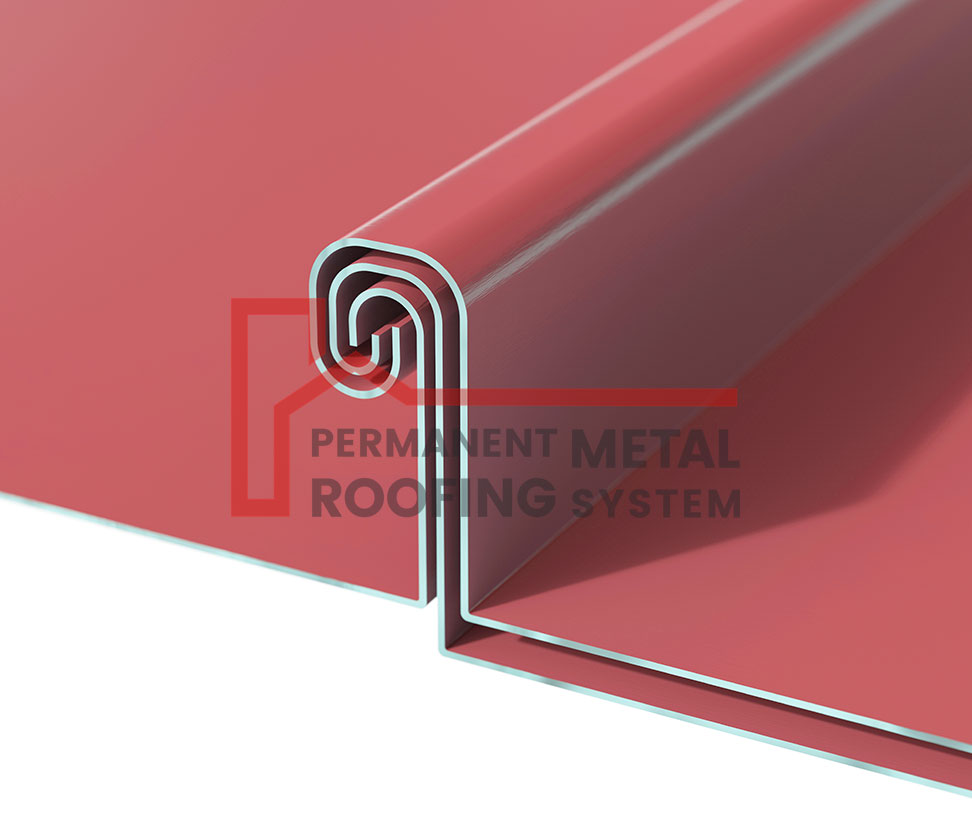
On a mechanical lock roof, our crew closes every seam on site with a power seamer, folding the panel legs to 90 degrees for a single lock or 180 for a double lock. That locked fold lets Permanent Metal Roofing Systems run panels as flat as 1/2:12 and keep them anchored on the most exposed DFW sites.
- 20+ years of experience
- Lifetime limited warranty
- Free written estimates
What makes a mechanically seamed roof different?
The seam is formed in place instead of pressed together. Each panel sets over concealed clips, then an electric seamer travels up the joint and bends both legs, with the clip tab trapped inside, into one tight fold.
Because the joint is locked rather than snapped, it stays closed on very low slopes where water lingers and on roofs where wind tries to pry panels apart. Seaming adds a step on every joint, so the labor runs higher than snap lock in the same metal.
Mechanically seamed systems seamed to specification can also qualify for an optional third-party weather-tightness warranty, which the owner can choose to purchase. Mechanical lock is one of two families in our standing seam roofing line, alongside snap lock.
Which mechanical lock size fits your project?
Pick by duty, support and metal. All three panels are rated to the same 1/2:12 minimum slope; they differ in seam height, width range, deck and the metals we can form.
| 1-inch mechanical lock | 1.5-inch mechanical lock | 2-inch mechanical lock | |
|---|---|---|---|
| Seam height | 1″ | 1-1/2″ | 2″ |
| Panel widths | Variable, 12″ to 20″ | Variable, 12″ to 20″ | Variable, 12″ to 18″ |
| Duty | Light: homes and light commercial | Heavy: homes and commercial | Heavy and structural |
| Seam fold | 90 or 180 degrees | 90 or 180 degrees | 45, 90 or 180 degrees |
| Steel | 26 or 24 ga | 26 or 24 ga | 26, 24 or 22 ga |
| Aluminum, copper, zinc | .032″ aluminum; 16 oz copper; .7 or .8 mm Rheinzink | .032″ aluminum; 16 oz copper; .7 or .8 mm Rheinzink | .032″ or .040″ aluminum; 16 or 20 oz copper; .7 or .8 mm Rheinzink |
| Minimum slope | 1/2:12 | 1/2:12 | 1/2:12 |
| Deck | Solid deck | Solid deck | Solid deck or open framing |
| Best use | Low porches, additions, bays and copper or zinc accents | Low-slope homes, long runs and uplift zones | Metal buildings, purlin-framed shops and long spans |
1-inch mechanical lock
The slimmest seamed profile we form puts a low, delicate seam on a roof that may be nearly flat. It suits a 1/2:12 back porch, a room addition or a copper bay window where a tall rib would look heavy.
1.5-inch mechanical lock
This heavy-duty panel is our first recommendation for low-slope houses. Its taller seam makes the pan stiffer and lifts the joint higher above standing water, which is why we chose it for our largest residential roof.
2-inch mechanical lock
The structural member of the family was designed for pre-engineered metal buildings. It spans open framing on a heavy-duty interlock clip that lets the panel expand and contract, and it offers the widest metal range: 22-gauge steel, .040″ aluminum and 20 oz copper. When a project specifies air and water testing, sealant is added inside the joint.
90 or 180 degrees: how many folds does your roof need?
Each further fold adds resistance to wind uplift and to water driven sideways, plus a little seaming time. We match the fold to the slope, the exposure and the project specification.
- 90 degrees (single lock). A clean, upright seam for pitched, sheltered roofs.
- 180 degrees (double lock). A second fold that we use on low slopes, long runs and roofs with stated uplift requirements.
- 45 degrees. A lighter partial fold, available on the 2-inch panel alone, for specifications that call for it.
On roofs pitched 3/12 or less, the panel data calls for Pro HT high-temperature underlayment beneath the panels, and we build to that spec.

Why do low-slope roofs in DFW need a mechanical seam?
Water moves slowly across a flat roof, so the seam has to stay sealed while water sits against it. A folded seam does that; a snap seam does not, which is why our snap lock stops at 3/12.
Low slopes are everywhere in the Metroplex: back porches, patio covers, room additions, modern shed roofs and flat sections tucked between gables. Shingles are not built for those pitches, and exposed-fastener panels put hundreds of screw heads in the water path.
Heat is the other load. A dark metal roof in a North Texas July runs far hotter than the air above it, which is why the high-temperature underlayment matters. We can also match the color and seam of your main roof on a porch or addition so the two read as one.
How does a mechanical seam handle DFW wind?
The folded seam makes it very hard for a gust to peel a panel open, which is the main reason we specify it on tall roofs and open sites.
North Texas storms bring more than hail. During the March 2025 outbreak, winds clocked near 105 mph tore into homes in Haltom City, and the storm of May 28, 2024 pushed wind near 80 mph across the metro. Uplift pulls hardest at eaves, corners and ridges.
Clip spacing, fastener type and deck attachment matter as much as the seam itself. When a job has stated uplift requirements, we follow the panel engineering and can arrange site-specific engineering on request.
Can you get copper, zinc or aluminum standing seam?
Yes, and mechanical lock is the profile for it. Every seamed size can be formed in 16 oz copper or Rheinzink zinc at .7 or .8 mm, and the 2-inch size adds 20 oz copper. Our copper and zinc roofing page covers those metals in detail.
Copper starts bright and darkens toward brown, turning green only slowly in a dry climate. Zinc weathers to a soft gray. Neither needs paint, so there is no finish to fade under Texas sun. Both are soft metals that dent in large hail, so we talk through exposure before you commit.
Aluminum in .032″ suits jobs where corrosion or weight comes first, and it takes the same PVDF colors as steel from our color chart.
A mechanical lock project from our files
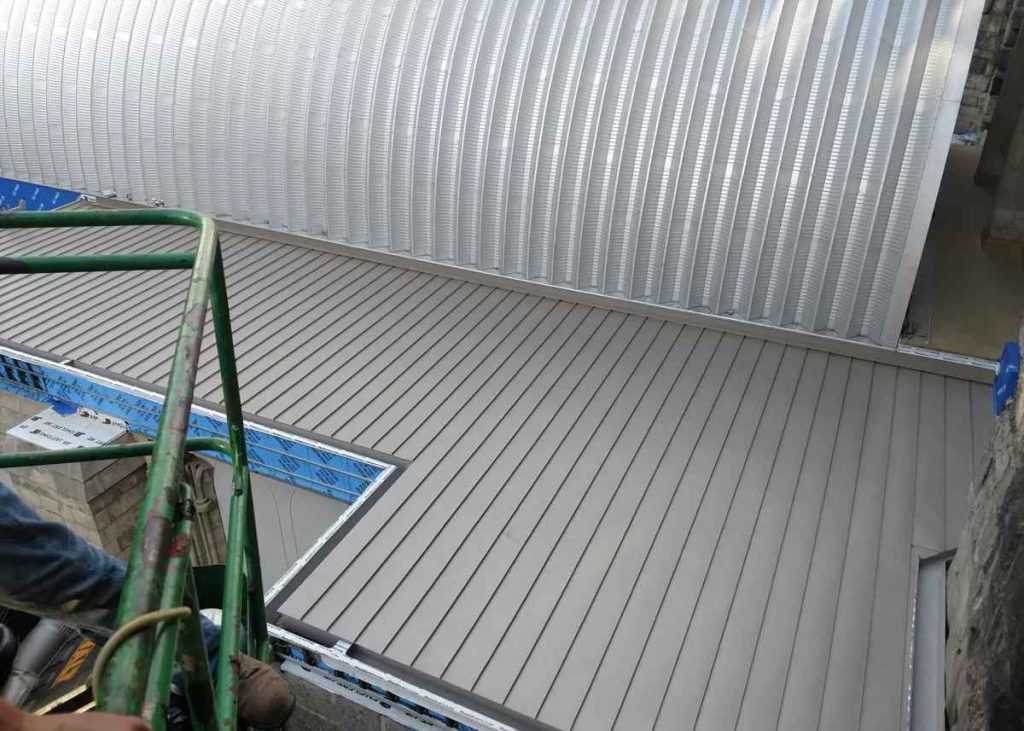
Our largest residential example is a home with about 10,000 square feet of 1.5-inch mechanical lock. Because that low-slope roof had stated uplift requirements, our crew double-locked each seam to 180 degrees, and the main panels ran a full 100 feet without an end lap.
The metal was .032 aluminum in PVDF, split between Charcoal Gray, Silver Metallic and Regal White, and the roof carries a third-party weather-tightness warranty. Runs that long only work when each panel is formed to the exact length of its run and held by clips that allow thermal movement, which is how we build every roof.
What sets the cost of a mechanical lock roof?
Plan on more than snap lock in the same metal, because seaming adds a step at every joint. You get the exact figure in a free, written, itemized estimate after we measure. These factors move it most.
- Roof size, slope and the number of valleys, walls and penetrations
- Seam height and whether the job calls for a single or double lock
- Metal: painted steel, aluminum, copper or zinc
- Tear-off layers, deck repairs and the high-temperature underlayment low slopes require
- Open framing, engineering or testing requirements on commercial work
The written estimate breaks out panels, trim, underlayment, tear-off and labor line by line. Our metal roof cost guide explains each factor.
Mechanical lock or snap lock?
Choose mechanical lock below 3/12, on high-wind sites, for long runs, or when you want copper, zinc or the optional weather-tightness coverage. Choose snap lock standing seam for an ordinary pitched roof where budget leads.
Our guide to snap lock vs. mechanical lock compares the two seam by seam, and the installation process page shows how a seamed roof goes on.
Mechanical lock questions from owners and builders
How is a single lock seam different from a double lock?
A single lock folds the seam to 90 degrees; a double lock folds it again, to 180. The second fold resists wind-driven water and uplift better, so we use it on low slopes and exposed roofs.
How low a slope can mechanical lock standing seam handle?
Each of our three seamed sizes can go as flat as 1/2:12. On slopes of 3/12 and under, the panel data calls for Pro HT high-temperature underlayment below the metal.
What is a weather-tightness warranty?
It is an optional third-party warranty, which the owner can purchase, that covers the roof system against leaks rather than just the materials against defects. It is available for mechanically seamed systems that are seamed to specification. Ask for the terms with your estimate, and see our warranties page for the coverage PMRS provides.
Can you install copper or zinc standing seam?
Yes. Our mechanical lock panels are formed in 16 oz copper and .7 or .8 mm Rheinzink zinc, and the 2-inch panel also comes in 20 oz copper.
Can a mechanical lock roof go over open framing?
Only the 2-inch panel. It spans purlins on a heavy-duty interlock clip, with clip spacing set by the project engineering. The two smaller sizes always go over a solid deck.
Is mechanical lock worth it on a steep roof?
Sometimes. On a steep, sheltered roof, snap lock usually does the job for less. Mechanical lock earns its cost on steep roofs with high wind exposure, very long panel runs, or copper and zinc.
Get Your Free Metal Roof Estimate
Tell us about your roof. Our Mesquite office calls back the same business day to set up a free measurement and an itemized written estimate.
Prefer to talk now? Call (469) 466-2421.
Have a low-slope roof or a set of plans?
Send us photos, measurements or drawings. We will recommend a seam, metal and finish for your roof, then send a written, itemized quote.