
Standing seam: snap lock
Snap Lock Standing Seam Metal Roofs for Dallas-Fort Worth
A snap lock standing seam roof locks each panel to its neighbor when the crew presses one seam leg down over the other. No seaming machine, no exposed screws. Permanent Metal Roofing Systems forms snap lock in three seam heights, 1, 1.5 and 1.75 inches, sized for Dallas-Fort Worth homes and buildings with a 3/12 pitch or more.
- 20+ years of experience
- Lifetime limited warranty
- Free written estimates
How does a snap lock seam work?
Two pieces do the work: a concealed clip and a pair of interlocking seam legs. The clip fastens to the roof deck and hooks the male leg of one panel. The female leg of the next panel then snaps down over it, covering the clip and every screw underneath.
Because nothing has to be folded with a power tool, snap lock goes on faster than a mechanically seamed panel and usually costs less in the same metal. The tradeoff is slope. A snap seam relies on water leaving the roof quickly, so we hold every snap lock size to 3/12 or steeper.
Snap lock is one of the two seam families in our standing seam metal roofing line. The other, mechanical lock, takes over on flatter and more exposed roofs.

Which snap lock size fits your roof?
Choose by the look you want, the support under the panels and how the roof meets the rest of the building. All three sizes share the same 3/12 minimum, so the decision comes down to seam height, width range and deck.
| 1-inch snap lock | 1.5-inch snap lock | 1.75-inch snap lock | |
|---|---|---|---|
| Seam height | 1″ | 1-1/2″ | 1-3/4″ |
| Panel widths | About 12″ to 16″ (16″ is our usual coverage) | Variable, 12″ to 20″ | Variable, 12″ to 18″ |
| Metals and gauges | Steel or aluminum; gauge confirmed for each job | 26, 24 or 22 ga steel; .032″ or .040″ aluminum | 26, 24 or 22 ga steel; .032″ or .040″ aluminum |
| Minimum slope | 3/12 | 3/12 | 3/12 |
| Deck | Solid deck | Solid deck | Solid deck or open framing |
| Seam detail | Low, simple snap seam | Narrow batten-cap seam over a rigid, continuous leg | Sealant bead applied as the panel is formed; optional snap-on batten |
| Best use | Dormers, bays, porch roofs and smaller homes | Roofs that carry on into a mansard or fascia | Whole-house and commercial roofs, carports and pavilions |
Figures for the 1-inch panel are typical values for the profile; we confirm its exact width, gauge and clip for your roof in writing. The 1.5-inch and 1.75-inch figures come from our own panel data.
1-inch snap lock
The lowest seam we form reads as fine pinstripes from the street, which keeps a small house, a dormer or a bay roof from looking top-heavy. It suits simple, steeper roofs with moderate panel runs, not long or highly exposed slopes.
1.5-inch snap lock
This is the architectural size, with the widest range of pan widths in the family. Its seam can turn from the main roof down a mansard or across a fascia without changing profile, so the lines never break.
1.75-inch snap lock
Our most requested snap lock adds spanning and uplift strength, and it is the only snap lock size we put over open framing as well as a solid deck. Where a project calls for air and water testing, the seam gets the specified sealant.

Where does snap lock fit on DFW homes and buildings?
Snap lock covers most pitched roofs in the Metroplex: brick ranches, two-story suburban homes, retail pads, churches and light commercial buildings. It is the wrong panel for a nearly flat porch or a low-slope addition.
Hail
When hail is the main worry, order 24-gauge steel, which carries about 28 percent more thickness than 26-gauge. Very large stones can still dent any metal panel. Insurance premium credits hinge on a UL 2218 Class 4 rated assembly, covered on our Class 4 metal roofing page, and our 24 vs. 26 gauge guide walks through the choice.
Heat and movement
North Texas averages roughly twenty 100-degree days each summer, and a dark panel gets far hotter than the air. Floating clips let each panel slide as it grows and shrinks, and high-temperature underlayment keeps the layer underneath from softening.
HOAs
Snap lock gives a roof clean vertical lines, a look many architectural committees approve. We prepare the color samples and product data your HOA asks for. Texas Property Code 202.011 narrows when an association may refuse hail-resistant or energy-saving roofing that suits the neighborhood. Its text refers to shingles, though, so expect a standing seam roof to go through architectural review.
How do we install a snap lock roof?
We install snap lock as a complete system, with panels formed to each run and trim bent for that roof. A typical residential job follows this order.
- Tear-off and a deck inspection, with damaged decking replaced where we find it.
- High-temperature underlayment over the whole deck, plus self-adhered membrane wherever water concentrates: eaves, valleys and penetrations.
- Drip edge, eave and valley flashing, bent in the roof color on our computerized equipment.
- Panels formed to the length of each run, clipped at the specified spacing and snapped together one course at a time. Over open framing, the 1.75-inch clips fasten to the purlins.
- Pipe boots, ridge vent or closures, and counter-flashing at walls and chimneys.
- A walk of every seam and flashing detail before cleanup.
The full sequence, from permits to the final walk-through, is on our installation process page.
What sets the cost of a snap lock roof?
Snap lock is usually the most economical way to get a standing seam roof, and the exact number comes from a free, written, itemized estimate after we measure. These are the factors that move it.
- Roof size, pitch and the number of hips, valleys, dormers and chimneys
- Seam height and panel width
- Metal and gauge: 26 or 24-gauge steel, 22-gauge, or aluminum
- Finish, from standard PVDF colors to Tedlar film
- Tear-off layers and any deck repairs found once the old roof is off
- Solid deck or open framing, and any engineering the job requires
Your estimate itemizes panels, trim, underlayment, tear-off and labor, so you can see where the money goes. Our metal roof cost guide explains each factor in more depth.
Snap lock or mechanical lock: which should you pick?
Pick snap lock for a pitched roof where speed and budget lead. Pick mechanical lock when the roof is flatter than 3/12, the site faces high wind uplift, or you want copper, zinc or the optional third-party weather-tightness warranty available on mechanically seamed systems.
- Roof below 3/12? Look at mechanical lock standing seam, with panels rated as low as 1/2:12.
- Roofing a shop, barn or barndominium on a tight budget? Compare corrugated and PBR metal roofs.
- Planning a copper turret or zinc bay? See copper and zinc roofing.
Our article on snap lock vs. mechanical lock covers the tradeoffs in more depth.
A snap lock project from our files
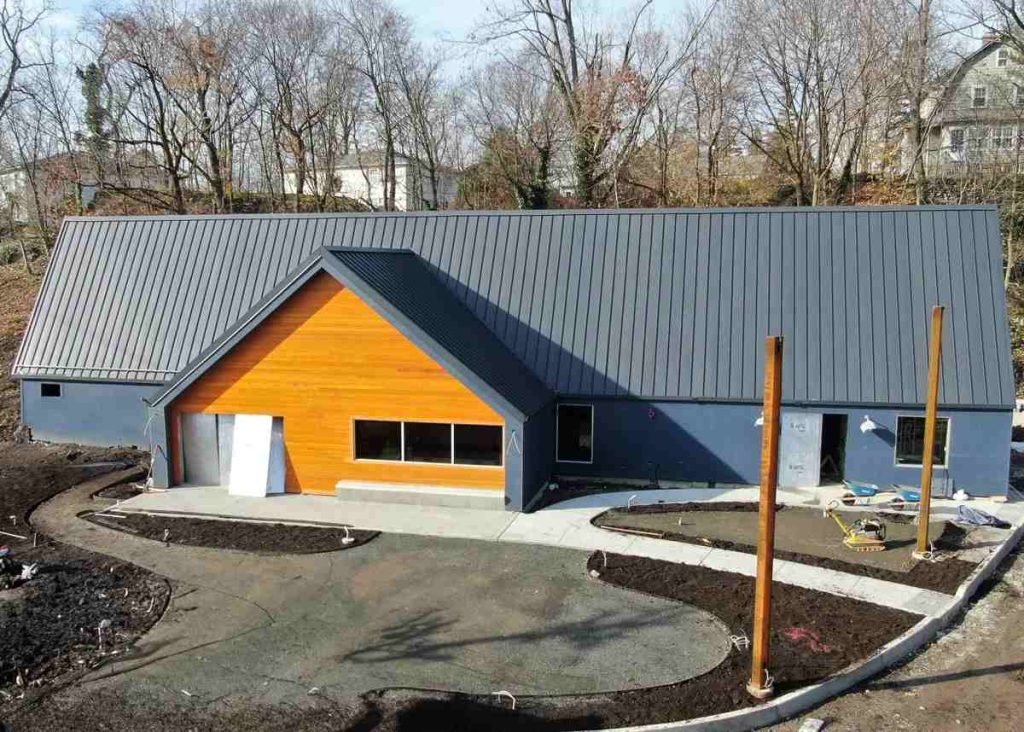
One retail building shows how far the profile can stretch. Every slope on it runs steeper than 3/12, and we roofed them with 1.5-inch snap lock panels in .032 aluminum, finished in matte black Tedlar PVF film.
Aluminum and film are not the usual pick for a house, but they show the range. On most homes we form the same panel in 24-gauge steel with a standard PVDF color from our metal roof color chart.
Snap lock questions we hear most
How steep does a roof need to be for snap lock?
Every PMRS snap lock size needs at least 3/12, a 3-inch rise over 12 inches of run. Flatter roofs need a mechanically seamed panel, and our mechanical lock panels are rated to 1/2:12.
Can snap lock panels span open framing?
Only one size can. We install the 1.75-inch panel over purlins or a solid deck, while the 1-inch and 1.5-inch sizes always need solid decking under them.
What warranty comes with a snap lock roof?
Your snap lock roof is covered by our Lifetime Non-Prorated Limited Warranty, which includes both material and labor. If you sell the home, it is transferable one time to the buyer. Acts of God, for example hail, tornadoes, fire or flood, are excluded because they are insurance matters. On top of that, our standard PVDF (Kynar 500 type) colors carry the coil coater’s 40-year finish warranty. Full terms are on our warranties page.
Which gauge should I choose for a snap lock roof in DFW?
On most DFW houses we suggest 24-gauge steel, since the thicker sheet shrugs off small hail better than 26-gauge. Heavier commercial roofs can step up to 22-gauge, and aluminum makes sense when corrosion or weight comes first.
Will snap lock panels hold up in high wind?
Wind performance comes from the clip type, the clip spacing and how the deck is attached. We follow the panel specification and can arrange site-specific engineering when a job has stated uplift requirements. On severe-uplift sites, a mechanically seamed panel is usually the safer pick.
Will my snap lock roof show oil canning?
Any flat metal pan can show a little waviness, called oil canning, and it is not a defect. Narrower pans, heavier gauge, a flat deck and optional striations all reduce it. Our oil canning guide explains why it happens.
Get Your Free Metal Roof Estimate
Tell us about your roof. Our Mesquite office calls back the same business day to set up a free measurement and an itemized written estimate.
Prefer to talk now? Call (469) 466-2421.
Ready to price a snap lock roof?
Tell us about the house or building. We will recommend a seam height, gauge and color, measure the roof, then quote it line by line in writing.